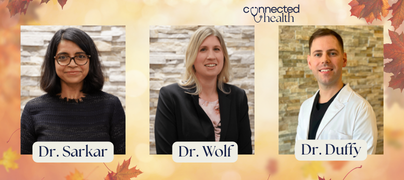
Why Dr. Sarkar Is Pursuing Lifestyle Medicine
At Connected Health, we believe some of the most meaningful conversations about your health happen before there is a problem to treat. How are you sleeping? What are you eating? Are you moving regularly? How are you managing stress? What habits could make a difference not just today, but years from now?
These are questions Dr. Chaitali Sarkar has long been passionate about, and now she is taking that interest a step further by working toward certification in Lifestyle Medicine and completing continuing medical education (CME) focused on this growing area of medicine.
Lifestyle Medicine uses evidence-based lifestyle interventions as part of the prevention and treatment of chronic disease, with a focus on six key pillars: nutrition, physical activity, restorative sleep, stress management, avoidance of risky substances, and positive social connection.
We sat down with Dr. Sarkar to learn more about Lifestyle Medicine, why she is pursuing additional training, and how she hopes to bring what she learns into her care at Connected Health.
Q: First, what exactly is Lifestyle Medicine?
Dr. Sarkar: Lifestyle Medicine looks at the everyday factors that have such a significant impact on our health—what we eat, how much we move, how well we sleep (and if you know me, you know I’m always going to talk about sleep!), how we manage stress, our relationships and social connections, and things like tobacco and alcohol use.
The goal is to use those lifestyle factors as part of medical care to help prevent and manage chronic disease. It isn't about replacing medications or other necessary medical treatments. It's about recognizing that our daily habits can be an important part of the treatment plan, too.
Q: What made you interested in pursuing certification in Lifestyle Medicine?
Dr. Sarkar: I've always been passionate about prevention and helping patients understand what they can do to take a more active role in their health. So many of the conditions we see every day are influenced by lifestyle, and I wanted to deepen my knowledge and have even more tools to help patients make changes that are realistic and sustainable.
Dr. Sarkar is excited to officially add a Lifestyle Medicine certification to her credentials, although the principles behind this approach have been part of the way she practices medicine for years. The certification is an opportunity to build on that foundation, expand her knowledge, and continue bringing these principles into the care she provides her patients.
Q: How does Lifestyle Medicine fit with the way you already practice at Connected Health?
Dr. Sarkar: I think it fits very naturally. At Connected Health, we have the time to really get to know our patients, not just their medical history or lab results, but their routines, challenges, goals, and what is happening in their lives.
Lifestyle Medicine is very personalized. There isn't one plan that works for everyone. Having more time with patients allows us to have those deeper conversations and work together on changes that make sense for that individual.
It also fits with our focus on being proactive rather than waiting until something is wrong. If we can identify risk factors earlier and help patients make meaningful changes, that's a very important part of preventative care. One of the reasons I made the decision to leave AHN and transition to concierge medicine was that I didn't feel I had enough time with my patients to truly dig deeper and get to the root cause of what they were experiencing.
Q: What are some of the main areas Lifestyle Medicine focuses on?
Dr. Sarkar: There are six main pillars: nutrition, physical activity, restorative sleep, stress management, avoiding risky substances, and positive social connection.
Looking at the bigger picture can help us understand where changes may have the greatest impact for an individual patient. These areas can play an important role in both preventing and managing chronic disease. For patients managing chronic conditions, it allows us to look beyond the diagnosis itself and identify realistic changes that can support their overall treatment plan and long-term health.
As part of my Lifestyle Medicine studies, I also completed a case study based on one of my own patients. We looked at how incorporating lifestyle changes into his care helped improve his cholesterol levels. It was a great real-world example of wh how meaningful, sustainable changes can make a measurable difference in a patient's health.
Q: How might patients see this additional training show up during their appointments with you?
Dr. Sarkar: I think patients may notice even more intentional conversations about their daily habits and how those habits relate to their health.
Instead of simply saying, “eat healthier” or “exercise more,” I want to help patients understand what that can actually look like in their everyday lives—and why I’m recommending certain changes.
Sometimes it can be something surprisingly simple. For example, even the way we prepare certain foods can make a difference. A cooled potato, like you might have in potato salad, can provide more resistant starch, which acts similarly to fiber in the body. It’s a good example of how small, practical changes can support our health.
That’s what I find valuable about Lifestyle Medicine. It gives me more evidence and tools to explain the “why” behind my recommendations rather than simply telling someone to eat better or exercise more. We can identify specific, achievable changes, set goals together, follow up on them, and adjust as needed.
For some patients, that may mean focusing more on nutrition or movement. For others, sleep or stress may be the place to start. It really depends on the person.
Q: What excites you most about bringing more Lifestyle Medicine into your patient care?
Dr. Sarkar: I love giving patients tools they can actually use in their everyday lives. I believe that medicine is not one-size-fits-all. Every patient is different, and you have to look at the whole person.
That’s what I really like about Lifestyle Medicine. It gives me another way to look at the whole patient and create a plan that is personalized to them and their health.
Continuing to Learn for Our Patients
Dr. Sarkar's pursuit of Lifestyle Medicine certification is another way our medical team continues to expand its knowledge and bring evidence-based approaches back to our patients.
The certification process is rigorous. As part of her training, Dr. Sarkar is completing 60 hours of medical education focused on Lifestyle Medicine, along with a case study based on her experience incorporating Lifestyle Medicine into the care of a patient. She will also sit for a certification exam at the completion of her training.
For Dr. Sarkar, this additional education reinforces something that has always been central to her approach to medicine: taking the time to understand the whole patient, identifying opportunities to be proactive, and recognizing that medicine is not one-size-fits-all.
We look forward to sharing more as Dr. Sarkar continues her training and works toward certification in Lifestyle Medicine.
%20(1).png)

%20(16).png)